



Helicobacter pylori infection remains one of the most common chronic bacterial infections worldwide. Its clinical relevance is reflected in international guidance such as the Maastricht VI/Florence Consensus Report on Helicobacter pylori management, which reviews diagnosis, treatment, prevention and gastric cancer-related aspects of H. pylori infection.
Although prevalence varies widely depending on region, age, socioeconomic background and access to healthcare, it is estimated to affect a very large proportion of the global population.
This high prevalence has important clinical implications. H. pylori is closely associated with chronic gastritis, peptic ulcer disease and gastric cancer, making reliable diagnosis and post-treatment follow-up essential in gastrointestinal care.
In this context, H. pylori stool antigen testing has become a key tool in non-invasive diagnosis. For clinical laboratories, its value lies not only in the result itself, but also in the ability to integrate testing into routine workflows in a practical, standardized and efficient way.
Why diagnosing H. pylori still matters
Helicobacter pylori infection can persist for years if left untreated. In many patients it may remain asymptomatic, but in others it is associated with persistent gastric inflammation and clinically relevant digestive complications.
Its link with conditions such as chronic gastritis, peptic ulcer disease and processes related to gastric cancer risk makes diagnosis and eradication confirmation important aspects of gastrointestinal management.
In addition, in a context of growing concern about antimicrobial resistance, confirming whether treatment has been successful is increasingly relevant. Treating the infection is not enough: it is also important to verify that H. pylori has been properly eradicated, especially in patients with persistent symptoms, clinical risk factors or follow-up needs.
Diagnostic methods for H. pylori infection
The diagnosis of Helicobacter pylori infection can be approached through invasive or non-invasive testing methods.In many routine scenarios, stool antigen testing plays an important role because it can support active infection detection and confirmation of H. pylori eradication after treatment.
Invasive H. pylori testing
Invasive methods usually require upper gastrointestinal endoscopy with gastric biopsy. Once the biopsy is obtained, different techniques can be used, including:
- Histology
- Culture
- Rapid urease testing
- Molecular testing in selected workflows
These methods can provide valuable clinical and microbiological information, especially in patients who require endoscopic evaluation. However, they also require specialized infrastructure, trained personnel and an invasive procedure.
For this reason, invasive testing is not always the most practical option for broad diagnostic access or routine follow-up.
Non-invasive H. pylori testing in clinical practice
In many routine scenarios, non-invasive H. pylori testing plays a central role. It allows laboratories and healthcare providers to test more patients efficiently, without the need for endoscopy.
The main non-invasive methods include:
- Urea breath test
- Serological testing
- Stool antigen testing
Each method has its own clinical role and limitations. Serology can indicate exposure but may not reliably distinguish between past and active infection. Urea breath testing is widely used and well established, but it requires specific equipment and patient preparation.
Among non-invasive options, stool antigen testing is especially valuable because it detects H. pylori antigen in stool samples and can support the identification of active infection when used according to clinical guidance.
The role of stool antigen testing
H. pylori stool antigen testing has become a particularly relevant option for laboratories that need accessible, scalable diagnostic solutions that fit routine practice.
Its main advantages include:
- It is non-invasive.
- It can be used across different patient groups.
- It helps detect active infection.
- It can support eradication confirmation after treatment.
- It integrates into gastrointestinal diagnostic workflows.
This is especially important because H. pylori management does not end with initial diagnosis. After treatment, eradication confirmation helps verify therapeutic success and supports better clinical decision-making.
For laboratories, this creates the need for assays that offer strong diagnostic performance, but also efficient and reproducible sample preparation.

Why workflow efficiency matters
In H. pylori diagnosis, analytical performance is essential, but it is not the only factor. The pre-analytical phase can have a major impact on laboratory efficiency, especially when working with stool samples.
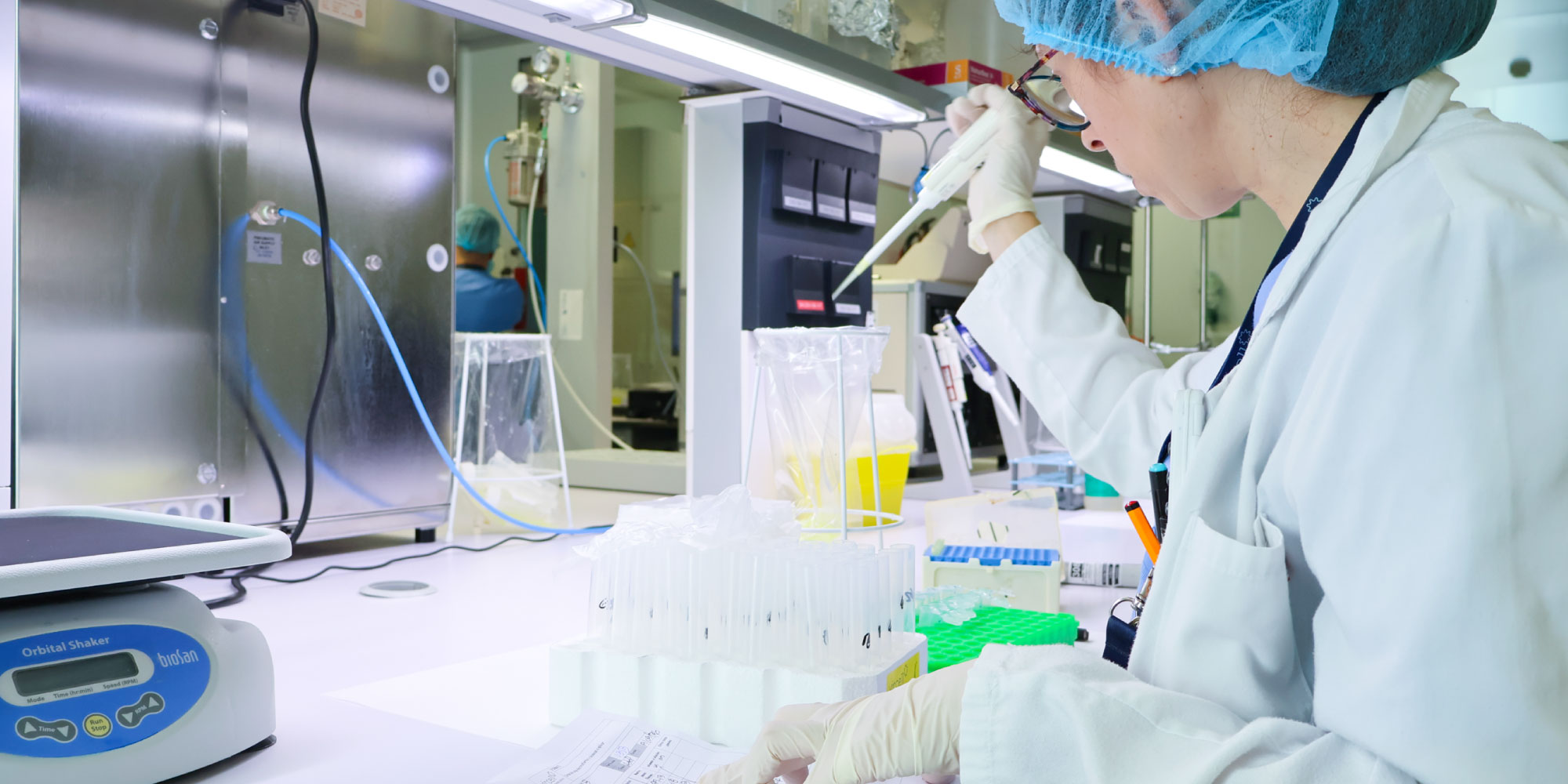
Preparing this type of sample may involve steps such as homogenization, clarification, filtration or centrifugation. Each additional step can increase hands-on time, introduce variability and make standardization between operators more difficult.
For this reason, an ideal solution for H. pylori stool antigen detection should combine:
- High sensitivity and specificity.
- Strong agreement with established methodologies.
- Simple and standardized sample preparation.
- Reduced hands-on time.
- Compatibility with automated platforms.
- Efficient handling of individual samples or variable workloads.
In laboratories with recurring gastrointestinal testing demand, these aspects can make a real difference in daily operations.
HELICOBACTER PYLORI Ag VIRCLIA® MONOTEST
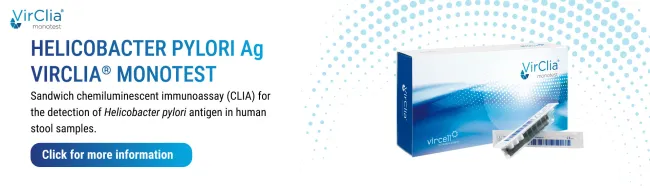
HELICOBACTER PYLORI Ag VIRCLIA® MONOTEST is a chemiluminescence immunoassay, or CLIA, designed for the detection of Helicobacter pylori antigen in stool samples.
The assay is intended to support laboratories that need a practical solution for H. pylori stool antigen testing, combining diagnostic performance with an efficient workflow.
In an internal retrospective evaluation using 313 previously characterized stool samples, the assay showed 86–89% relative sensitivity, 98% relative specificity and over 94% overall agreement compared with established reference methodologies.
In addition, when compared against a consensus result built from multiple independent techniques, with VirClia® excluded from the consensus to avoid bias, the results were:
- Sensitivity: 91%
- Specificity: 98%
- Correlation: 96%
- ROC AUC: 0.970
- Cohen’s kappa: 0.906
These data support the robustness of the assay for H. pylori antigen detection in stool samples and show strong agreement with established diagnostic approaches.
A key differentiator: simplified sample preparation
One of the distinguishing features of HELICOBACTER PYLORI Ag VIRCLIA® MONOTEST is its integrated stool sample preparation system, which includes a dedicated filtering device and pre-filled sample tubes. For laboratories looking to automate and standardize infectious disease workflows, the assay can be integrated into the VirClia® automated chemiluminescence platform and the VirClia® Lotus automated CLIA analyser.
This design removes the need for centrifugation, an additional step commonly required in many traditional ELISA or CLIA stool workflows.
By simplifying the pre-analytical phase, laboratories can:
- Reduce hands-on time.
- Increase standardization.
- Limit operator-dependent variability.
- Improve sample processing efficiency.
- Support more consistent workflows.
In practice, this makes stool antigen detection easier to integrate into routine laboratory activity, especially when working with variable workloads or individual samples.
Conclusión
Helicobacter pylori infection continues to represent a significant burden for healthcare systems worldwide. Its association with chronic gastritis, peptic ulcer disease and gastric cancer makes reliable diagnosis and post-treatment follow-up essential.
Stool antigen testing plays an important role in the non-invasive diagnosis of H. pylori, particularly when laboratories need to detect active infection and confirm eradication after treatment.
With HELICOBACTER PYLORI Ag VIRCLIA® MONOTEST, Vircell offers a CLIA-based solution for H. pylori antigen detection in stool samples, combining diagnostic performance, monotest format and simplified pre-analytical preparation to support clinical laboratory workflows.






DO YOU HAVE ANY QUESTIONS?
Contact us