


Helicobacter pylori remains a highly relevant target in gastrointestinal diagnostics. It is a familiar pathogen, but its clinical importance has not disappeared. H. pylori infection is associated with chronic gastritis, peptic ulcer disease, MALT lymphoma and gastric cancer, and continues to generate a steady diagnostic demand in clinical laboratories.
Recent reviews, including the Nature Reviews Disease Primers article on Helicobacter pylori infection, highlight the ongoing relevance of this pathogen in gastrointestinal disease. International guidance, such as the World Gastroenterology Organisation guideline on H. pylori and the Maastricht VI/Florence Consensus Report, also continues to recognise the importance of appropriate diagnosis and management.
For laboratories, this means H. pylori testing is not an occasional task. It is part of a real and sustained workflow.
But the conversation has evolved. The question is no longer only whether laboratories should test for H. pylori. That need is already well established. The real question is how this testing can be integrated into routine laboratory workflows in a way that is efficient, objective and traceable.
Non-invasive H. pylori testing is now part of routine diagnosis
Non-invasive testing is firmly established in H. pylori diagnostic pathways. Depending on the clinical context, the main options include:
- urea breath testing
- stool antigen testing
- serology
These methods are used for different diagnostic questions. Some help detect active infection, while others may support broader clinical assessment or immune response evaluation.
Within this framework, H. pylori stool antigen testing has a particularly important role. It supports the detection of active infection and can also be used in follow-up strategies when performed under appropriate conditions.
This is especially relevant after treatment. The ACG 2024 guideline highlights on H. pylori treatment state that eradication should be confirmed using an appropriate method, such as a fecal antigen test, urea breath test or biopsy-based test.
In other words, stool antigen detection is not only useful for initial diagnosis. It also supports the practical need to confirm whether treatment has been successful.
From diagnostic validity to workflow reality
The clinical value of H. pylori stool antigen testing is well understood. What increasingly matters is how the test fits into daily laboratory practice.
Many laboratories are dealing with:
- irregular sample volumes
- pressure to reduce manual steps
- a need for standardised processes
- faster turnaround expectations
- traceability requirements
- connectivity with laboratory information systems
- variable demand throughout the day
A test can be clinically useful and still create friction in the lab. This is particularly true in stool sample workflows, where pre-analytical handling, sample preparation, timing, interpretation and traceability can all affect routine organisation.
At low volumes, these steps may be manageable. But when demand increases, or when samples arrive unpredictably, manual or batch-based workflows can become less convenient.
That is why H. pylori stool antigen testing is now linked not only to non-invasive diagnosis, but also to workflow design.
The practical question becomes: can the laboratory obtain a reliable result while reducing unnecessary operational complexity?
What automation can add to H. pylori stool antigen testing
Automation is not valuable simply because it is automation. It becomes valuable when it helps laboratories work in a more consistent, flexible and traceable way.
In H. pylori stool antigen testing, automation can support:
- reduced hands-on time
- more standardised sample processing
- objective result interpretation
- individual sample management
- better traceability
- easier integration with reporting workflows
- less dependence on batch-based testing
This can be especially useful when laboratories do not receive predictable sample volumes, or when they need to process individual samples without waiting to build a full run.
For H. pylori testing, the ideal workflow should not only detect the target. It should also help the laboratory manage routine pressure more efficiently.
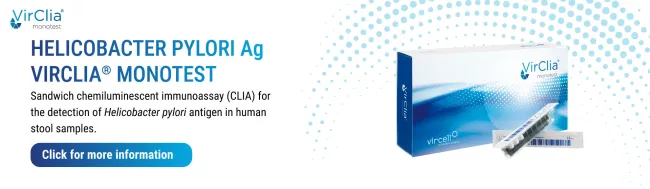
HELICOBACTER PYLORI Ag VIRCLIA® MONOTEST
HELICOBACTER PYLORI Ag VIRCLIA® MONOTEST is an automated CLIA solution for the detection of H. pylori antigen in human stool samples.
It is designed to support laboratories that need flexible, on-demand testing without relying on large batches. Its monotest format follows a simple logic: one sample, one test.
Key workflow advantages include:
- simple pre-analytical preparation, without routine centrifugation
- results in approximately one hour
- monotest format for individual sample processing
- on-demand testing
- objective interpretation by the analyser
- individual quality control per monotest
- full process traceability
- LIS connectivity to support result reporting
- compatibility with the VIRCLIA® LOTUS automated workflow
This makes the solution particularly useful for laboratories that need flexibility, manage variable sample volumes or want to reduce dependence on manual or batch-based processes.
The assay can be integrated with the VirClia® automated chemiluminescence platform. For laboratories looking for continuous loading and random access, VirClia® Lotus supports a more flexible CLIA workflow for infectious disease testing.

A more practical way to look at H. pylori testing
The relevance of H. pylori is clear. The role of non-invasive testing is also well established. What is becoming more important is how laboratories organise this testing in practice.
For many laboratories, the challenge is no longer simply having access to an H. pylori stool antigen test. It is having a solution that supports a more efficient, standardised and traceable workflow.
In this sense, stool antigen detection is not just a diagnostic option. When integrated into an automated and on-demand system, it can also become a practical workflow solution.
This is where the conversation around H. pylori testing continues to evolve: from prevalence and clinical need to laboratory efficiency, process quality and routine implementation.
Complementary H. pylori solutions
Vircell also offers complementary solutions for H. pylori diagnostic workflows.
HELICOBACTER PYLORI VIRCLIA® IgA / IgG supports automated serology workflows in monotest format, helping laboratories manage infectious serology with flexibility.
For laboratories considering broader prevention strategies, the IARC/WHO report on population-based H. pylori screen-and-treat strategies also reflects the growing public health interest in structured H. pylori detection and treatment approaches for gastric cancer prevention.
Conclusion
H. pylori testing remains clinically relevant, but modern laboratories need more than diagnostic validity. They need workflows that are efficient, objective, traceable and easy to integrate into routine practice.
H. pylori stool antigen testing plays an important role in non-invasive diagnosis and eradication confirmation. When supported by automation, monotest design and LIS connectivity, it can also help laboratories manage real-world workload more effectively.
HELICOBACTER PYLORI Ag VIRCLIA® MONOTEST supports automated, on-demand stool antigen detection for laboratories that need flexibility without compromising workflow control.
In today’s laboratory, H. pylori testing is no longer only about detection. It is also about making the diagnostic process work better.


MORE PUBLICATIONS




DO YOU HAVE ANY QUESTIONS?
Contact us