



Invasive aspergillosis is still one of the most difficult fungal infections to diagnose early. It mainly affects patients with weakened immune systems, such as people with haematological malignancies, transplant recipients or patients receiving intensive immunosuppressive treatment.
The challenge is that invasive aspergillosis does not always look obvious at first. Symptoms can be non-specific, imaging results need clinical interpretation and culture is not always positive. In these cases, laboratories need tools that can provide useful information quickly.
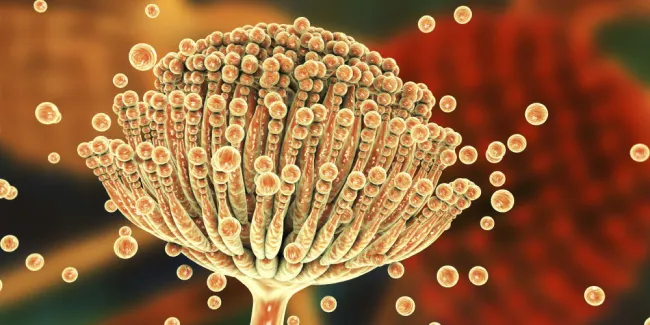
One of the most established biomarkers is galactomannan, a polysaccharide released by Aspergillus during fungal growth. As CDC explains in its clinical overview of aspergillosis, galactomannan antigen testing detects a component of the Aspergillus cell wall and can help support diagnosis in the right clinical context.
For the laboratory, the key question is not only whether galactomannan can be detected. It is also whether testing can be performed in a way that is fast, flexible and reliable in routine practice.
Why early diagnosis matters
Invasive pulmonary aspergillosis can progress quickly, especially in high-risk patients. Early diagnosis can help clinicians start or adjust antifungal treatment, monitor the patient more closely and assess the risk of progression or dissemination.
However, diagnosis is rarely based on one result alone. It usually brings together several elements: clinical risk factors, radiology, microbiology, biomarkers and, when available, histopathology.
The IDSA aspergillosis guideline supports the use of serum and bronchoalveolar lavage, or BAL, galactomannan as a useful marker in specific high-risk groups, including patients with haematological malignancy or haematopoietic stem cell transplantation.
This makes the galactomannan test an important part of the diagnostic strategy, particularly when clinicians need timely information to guide decisions.
What galactomannan adds to Aspergillus diagnosis
Galactomannan is released during active growth of Aspergillus. Detecting it can provide valuable evidence when invasive aspergillosis is suspected.
In routine laboratory practice, galactomannan testing can be performed in different sample types, including:
- serum
- plasma
- bronchoalveolar lavage, or BAL
BAL galactomannan is especially useful in suspected pulmonary infection because it comes from the respiratory compartment. Serum galactomannan and plasma testing can also support diagnosis in selected high-risk patients.
The updated EORTC/MSGERC definitions include galactomannan thresholds to support the classification of probable invasive aspergillosis. More detail is available in this article on galactomannan positivity in the updated EORTC/MSGERC definitions.
As with any biomarker, the result should not be interpreted in isolation. It should be considered together with the patient’s risk profile, imaging findings and other laboratory results.
Why workflow flexibility matters
In many laboratories, suspected invasive aspergillosis does not arrive as a neat batch of samples. It may be one urgent BAL sample, one serum sample from a high-risk patient or a small number of samples that need a same-day answer.
That is why workflow flexibility matters. A practical galactomannan testing solution should help laboratories:
- process urgent samples
- avoid waiting for sample accumulation
- reduce hands-on time
- support standardised testing
- work with clinically relevant sample types
- deliver results in a useful timeframe
In fungal diagnostics, speed and reliability need to work together. A fast result is only valuable if the workflow is controlled, consistent and easy to integrate into daily practice.
ASPERGILLUS GALACTOMANNAN Ag VIRCLIA® MONOTEST
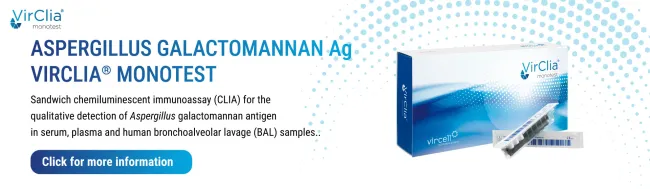
ASPERGILLUS GALACTOMANNAN Ag VIRCLIA® MONOTEST is a sandwich chemiluminescent immunoassay, or CLIA, for the qualitative detection of Aspergillus galactomannan antigen in serum, plasma and human BAL samples.
It is designed for laboratories that need on-demand testing without waiting to build a batch. Its monotest format allows individual sample processing, making it suitable for urgent samples and low-to-medium volume workflows.
Key advantages include:
- monotest format with ready-to-use reagents
- automated CLIA detection
- compatibility with serum, plasma and BAL
- results in approximately 1 hour
- calibrator and negative control included in each monodose
- flexible configuration of samples and reagents
- compatibility with VirClia® automation
The assay can be integrated into the VirClia® automated chemiluminescence platform and processed on VirClia® Lotus, helping laboratories combine automation, flexibility and rapid response.
Quality control also matters
Reliable fungal diagnostics also depend on good quality control. In galactomannan testing, laboratories need confidence in both the analytical detection step and the wider workflow.
VIRCELL® ASPERGILLUS GALACTOMANNAN Ag CONTROL is designed as an independent external control for Aspergillus galactomannan antigen detection, covering both sample pretreatment and analytical detection.
For laboratories working with molecular methods, Vircell also offers AMPLIRUN® ASPERGILLUS FUMIGATUS DNA CONTROL, a purified DNA control of Aspergillus fumigatus for nucleic acid amplification-based research techniques.
Together, these solutions can support a more complete approach to Aspergillus diagnostics and quality control.
Conclusion
Aspergillus galactomannan is a practical and clinically relevant biomarker for supporting invasive aspergillosis diagnosis, especially in high-risk patients and suspected pulmonary infection.
For laboratories, its value depends not only on the biomarker itself, but also on how well the test fits real diagnostic workflows. Urgent samples, BAL testing, low sample volumes and the need for fast results all make flexibility essential.
ASPERGILLUS GALACTOMANNAN Ag VIRCLIA® MONOTEST supports automated, on-demand galactomannan testing in serum, plasma and BAL samples, helping laboratories respond faster and work more efficiently.
In invasive aspergillosis, early information can make a difference. A flexible and reliable galactomannan workflow helps laboratories support clinical teams when timing matters.





DO YOU HAVE ANY QUESTIONS?
Contact us