
Background on Aspergillus and Galactomannan Detection
Aspergillus species are ubiquitous environmental fungi that can cause a wide spectrum of diseases, ranging from allergic manifestations to severe invasive infections. Among them, Aspergillus fumigatus is the species most commonly associated with invasive aspergillosis (IA), a life-threatening fungal infection.
The diagnosis of invasive aspergillosis remains a clinical challenge, as signs and symptoms are often nonspecific, and conventional methods such as microbiological culture and histopathology may be limited by insufficient sensitivity or difficulties in obtaining appropriate specimens. Consequently, culture-independent biomarkers have become essential tools in the diagnostic evaluation of patients at risk for invasive fungal disease.

Product features
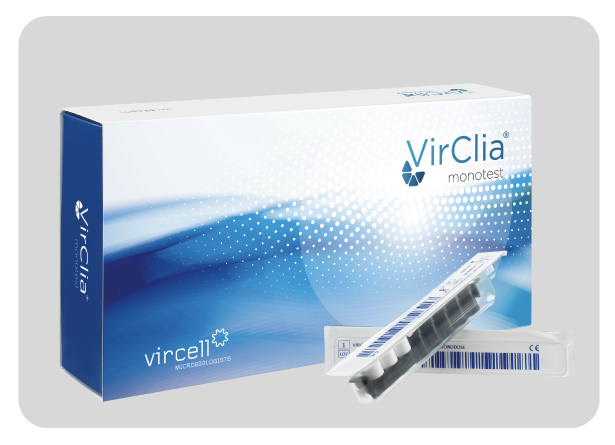
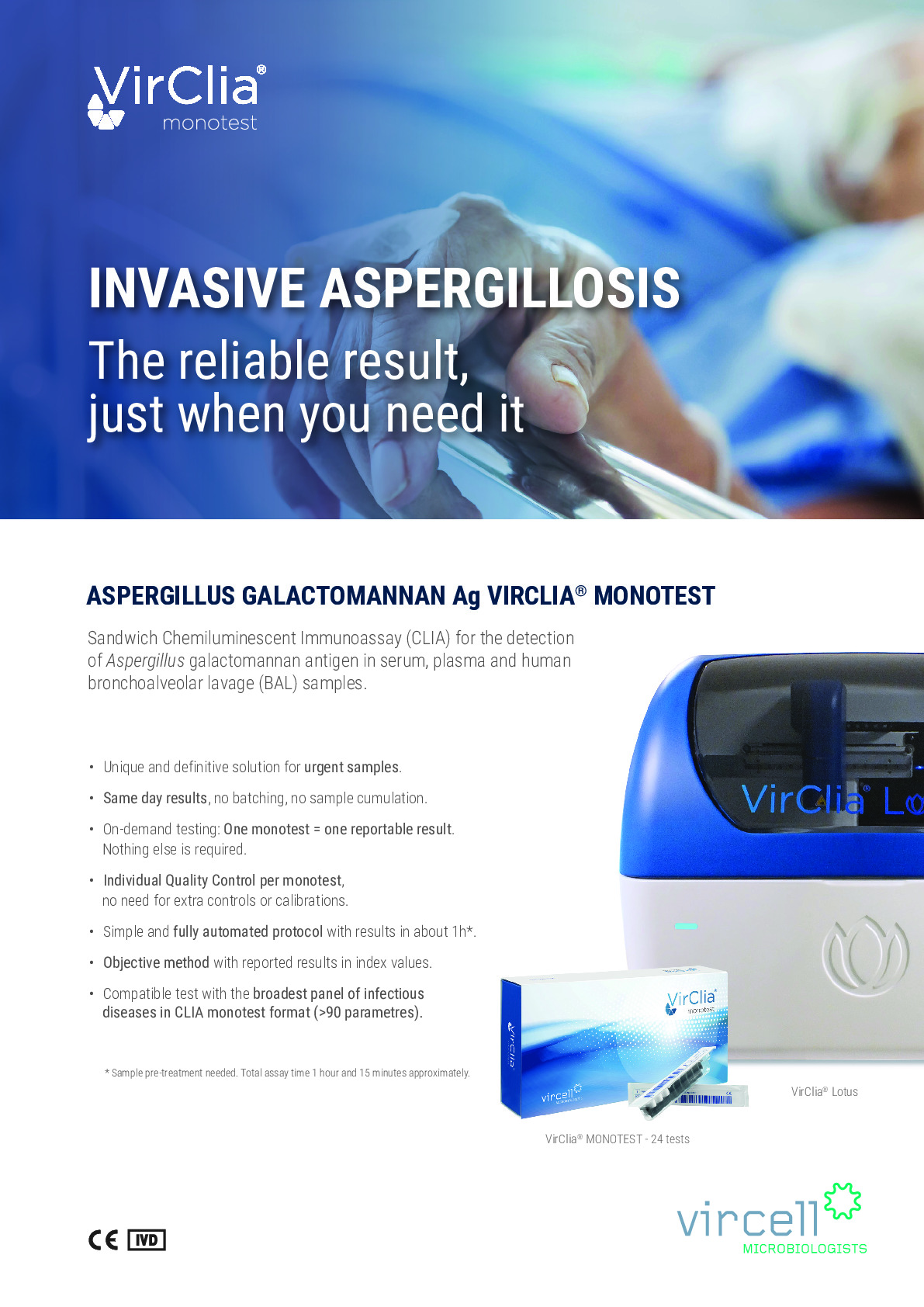
Sandwich chemiluminescent immunoassay (CLIA) for the detection of Aspergillus galactomannan antigen in serum, plasma and human bronchoalveolar lavage samples.
- Monotest format with ready-to-use reagents.
- Simple and automated protocol, with fast results.
- Customizable configuration of samples and reagents according to laboratory needs.
- Each monotest includes a calibrator and a negative control, enabling individual validation and interpretation of each sample.
- Use of primary tubes, with no need for manual pipetting.
Diagnostic Recommendations
Aspergillus galactomannan antigen
- A positive result indicates detection of galactomannan antigen and supports the diagnosis of invasive aspergillosis in patients with compatible risk factors, clinical findings and imaging.
- Galactomannan should be interpreted as mycological evidence within the diagnostic algorithm, not as a stand-alone diagnostic criterion.
- A positive result does not confirm fungal viability, does not identify the Aspergillus species and does not provide information on antifungal susceptibility.
- A negative result does not exclude invasive aspergillosis, especially when the antigen burden is low, the sample is suboptimal or the patient is receiving mould-active antifungal prophylaxis or treatment.
- In serum or plasma, the test is especially useful in selected high-risk patients, such as those with haematological malignancies or allogeneic haematopoietic stem cell transplantation.
- In BAL, galactomannan may support the diagnosis of pulmonary aspergillosis, but it should be assessed together with clinical suspicion and the risk of colonization.
- Results close to the cut-off should be interpreted with caution. Repeating the test or obtaining consecutive positive results may increase diagnostic confidence.
- Possible false-positive results or cross-reactivity with other fungi, including Penicillium spp., Fusarium spp., Histoplasma spp., Cryptococcus spp. and Blastomyces spp., should be considered within the patient’s clinical and microbiological context.
- Results should be interpreted together with radiology, culture, histology, PCR or other fungal biomarkers when available.
Sources
Patterson TF, Thompson GR III, Denning DW, Fishman JA, Hadley S, Herbrecht R, et al. Practice Guidelines for the Diagnosis and Management of Aspergillosis: 2016 Update by the Infectious Diseases Society of America. Clin Infect Dis. 2016;63(4). doi:10.1093/cid/ciw326.
Donnelly JP, Chen SC, Kauffman CA, Steinbach WJ, Baddley JW, Verweij PE, et al. Revision and Update of the Consensus Definitions of Invasive Fungal Disease From the EORTC and the Mycoses Study Group Education and Research Consortium. Clin Infect Dis. 2020;71(6):1367-1376. doi:10.1093/cid/ciz1008.
PRODUCTS
ASPERGILLUS GALACTOMANNAN AG VIRCLIA® MONOTEST
Analytes: Aspergillus
USED ON
VIRCLIA® LOTUS
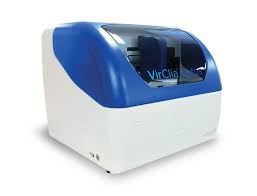
A compact automated CLIA platform for VirClia® infectious disease testing, combining ready-to-use single-test flexibility with continuous random access efficiency.
MORE RESOURCES

Related germs and organisms categorized for this product line.

Downloadable PDF materials, brochures, and technical documents.

The latest insights, news, and research articles from our scientific team.

Understanding the complexity of vaginal infectionsVaginal infections are among the most frequent reasons for gynecological consultation, but their dia...

Beyond detection: H. pylori testing in today’s laboratory workflow
Helicobacter pylori remains a highly relevant target in gastrointestinal diagnostics. It is a familiar pathogen, but its clinical importance has not d...

Aspergillus galactomannan: a practical biomarker for invasive aspergillosis diagnosis
Invasive aspergillosis is still one of the most difficult fungal infections to diagnose early. It mainly affects patients with weakened immune systems...

Scientific bibliography and references related to this product.