
Background
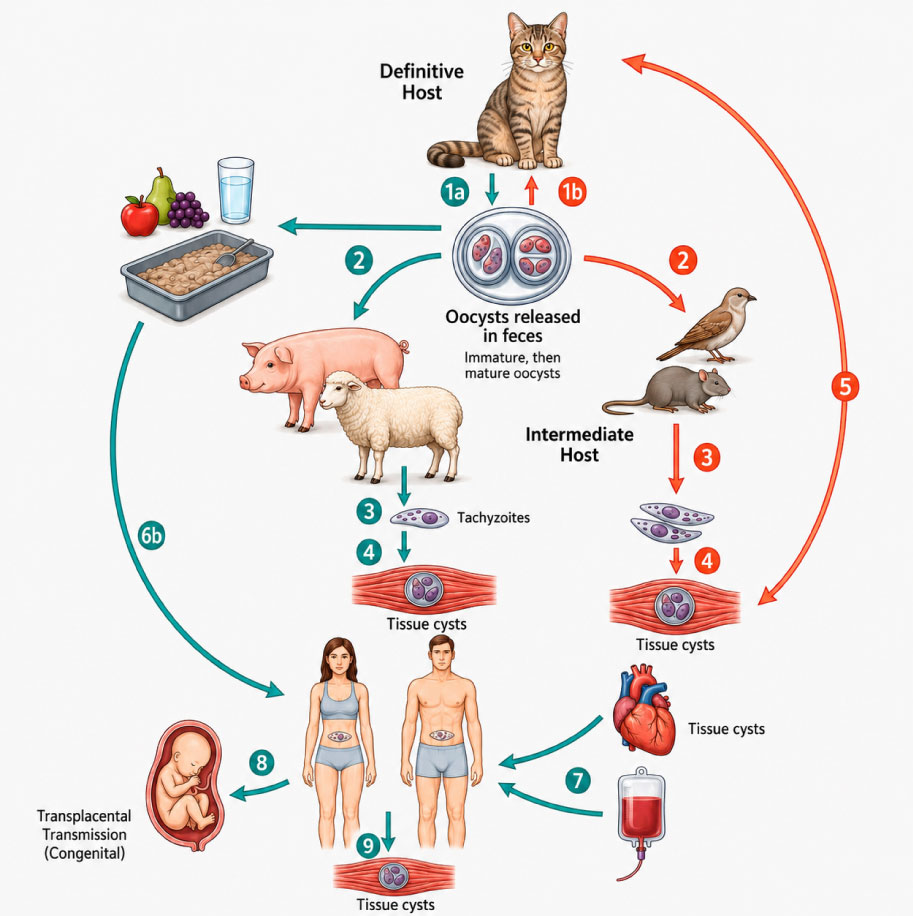
Toxoplasmosis is a widely distributed infection caused by Toxoplasma gondii, an intracellular protozoan parasite. The cat acts as the definitive host of the parasite, and in humans, infection is mainly associated with the consumption of contaminated or undercooked food, as well as exposure to oocysts present in the environment. In certain situations, maternal-fetal transmission may also occur during pregnancy or, less commonly, in the context of organ transplantation.
In most immunocompetent individuals, primary infection goes unnoticed or is associated with non-specific symptoms. However, its clinical relevance increases significantly in certain settings. During pregnancy, a primary infection may lead to congenital toxoplasmosis, with possible ocular and neurological sequelae. In immunocompromised patients, reactivation of a latent infection may cause severe disease, especially involving the central nervous system. For this reason, serology plays a particularly important role in the diagnostic approach to pregnant women, newborns with suspected congenital infection, and immunosuppressed patients.
Product features
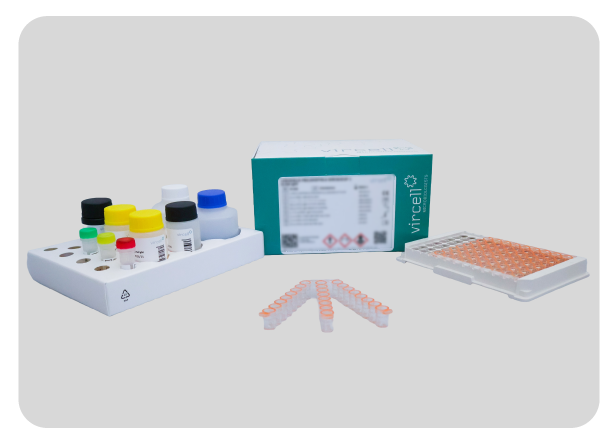
Assays based on the indirect ELISA method, where antibodies present in the sample react with antigens bound to the surface of the wells. Products identified as CAPTURE use µ-Capture technology for IgM detection.
Direct in-well sample dilution and equivalent processing of samples and controls to help compensate pipetting variability.
Colour-coded, ready-to-use liquid reagents and individual break-apart wells.
Suitable for manual processing and compatible with automated ELISA systems.
The G1027 reference includes calibrators for additional semi-quantification protocol
Diagnostic recommendations
Toxoplasma gondii serology
Positive IgG indicates previous exposure to Toxoplasma gondii, but does not by itself determine when the infection occurred.
Qualitative IgG helps identify seronegative and susceptible patients, especially in pregnancy screening.
Quantitative IgG may support serological follow-up. Seroconversion or a significant increase in IgG in paired samples collected 2–4 weeks apart and analysed with the same method suggests recent infection.
A positive IgM result may suggest recent infection, but it should be interpreted with caution, as it may persist for months or years and may show non-specific reactivity.
In IgG-positive / IgM-positive profiles, IgG avidity helps differentiate recent infection from past infection, especially during pregnancy.
High avidity supports past infection and helps exclude a recently acquired infection.
Low or intermediate avidity does not confirm recent infection on its own; it should be assessed together with IgG, IgM, serological follow-up and the clinical context.
In pregnant women with suspected recent infection, maternal serology may require confirmation or complementary techniques, such as PCR in amniotic fluid when indicated.
In neonates, IgG should be interpreted with caution because of maternal transfer. Persistence of IgG during follow-up or detection of specific IgM supports congenital infection.
In immunocompromised patients, serology has limitations for the diagnosis of active disease; direct detection techniques may be required depending on the clinical presentation.
Sources:
Centers for Disease Control and Prevention. Toxoplasmosis: clinical overview. Atlanta: CDC; [consulted 2026 Jul 1]. Available from: Clinical Overview of Toxoplasmosis
Centers for Disease Control and Prevention. DPDx: toxoplasmosis. Atlanta: CDC; [consulted 2026 Jul 1]. Available from: https://www.cdc.gov/dpdx/toxoplasmosis/index.html
PRODUCTS
TOXOPLASMA ELISA IgG
Analytes: Toxoplasma gondii
TOXOPLASMA ELISA IgM CAPTURE
Analytes: Toxoplasma gondii
MORE RESOURCES

Related germs and organisms categorized for this product line.

Downloadable PDF materials, brochures, and technical documents.

The latest insights, news, and research articles from our scientific team.

Understanding the complexity of vaginal infectionsVaginal infections are among the most frequent reasons for gynecological consultation, but their dia...

Beyond detection: H. pylori testing in today’s laboratory workflow
Helicobacter pylori remains a highly relevant target in gastrointestinal diagnostics. It is a familiar pathogen, but its clinical importance has not d...

Aspergillus galactomannan: a practical biomarker for invasive aspergillosis diagnosis
Invasive aspergillosis is still one of the most difficult fungal infections to diagnose early. It mainly affects patients with weakened immune systems...

Scientific bibliography and references related to this product.