
Product features
Indirect chemiluminescent immunoassay to test antibodies against Toxoplasma gondii in human serum/plasma.
- Complete solution as an aid in the diagnosis of cytomegalovirus: CMV IgM, CMV IgG and CMV IgG avidity.
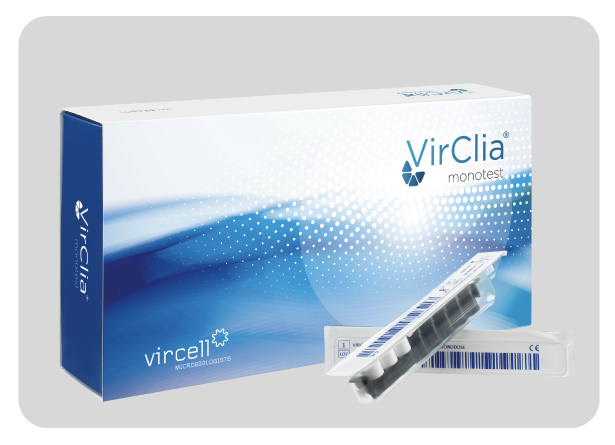
- Monotest format with ready-to-use reagents.
- Highly specific IgM immunocapture method.
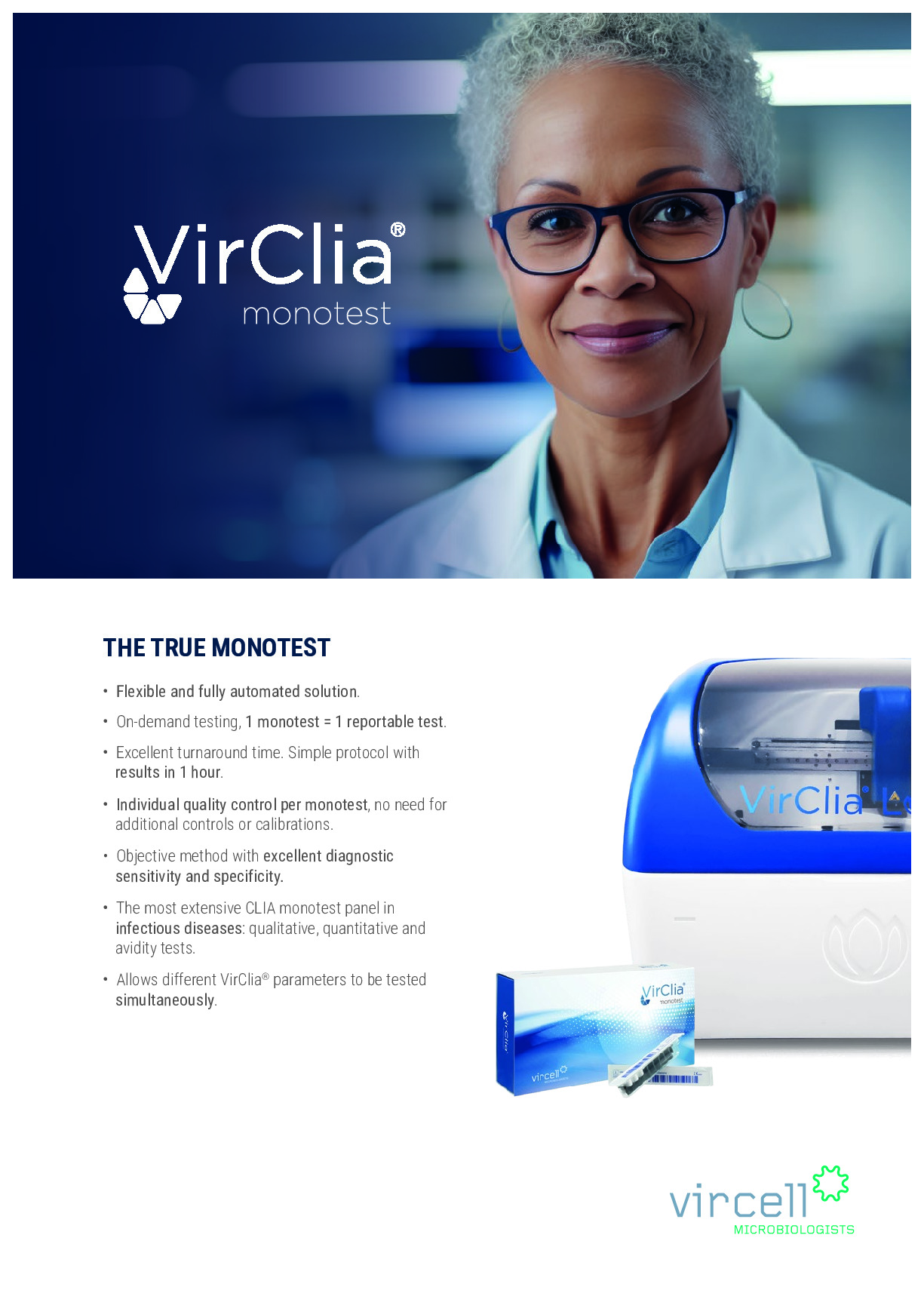
- Simple and automated protocol, with fast results.
- Customizable configuration of samples and reagents according to laboratory needs.
- Each monotest includes a calibrator and a negative control, enabling individual validation and interpretation of each sample.
- Use of primary tubes, with no need for manual pipetting.
Diagnostic Recommendations
Toxoplasma gondii serology
Positive IgG indicates previous exposure to Toxoplasma gondii, but does not by itself determine when the infection occurred.
Qualitative IgG helps identify seronegative and susceptible patients, especially in pregnancy screening.
Quantitative IgG may support serological follow-up. Seroconversion or a significant increase in IgG in paired samples collected 2–4 weeks apart and analysed with the same method suggests recent infection.
A positive IgM result may suggest recent infection, but it should be interpreted with caution, as it may persist for months or years and may show non-specific reactivity.
In IgG-positive / IgM-positive profiles, IgG avidity helps differentiate recent infection from past infection, especially during pregnancy.
High avidity supports past infection and helps exclude a recently acquired infection.
Low or intermediate avidity does not confirm recent infection on its own; it should be assessed together with IgG, IgM, serological follow-up and the clinical context.
In pregnant women with suspected recent infection, maternal serology may require confirmation or complementary techniques, such as PCR in amniotic fluid when indicated.
In neonates, IgG should be interpreted with caution because of maternal transfer. Persistence of IgG during follow-up or detection of specific IgM supports congenital infection.
In immunocompromised patients, serology has limitations for the diagnosis of active disease; direct detection techniques may be required depending on the clinical presentation.
Sources:
Centers for Disease Control and Prevention. Toxoplasmosis: clinical overview. Atlanta: CDC; [consulted 2026 Jul 1]. Available from: Clinical Overview of Toxoplasmosis
Centers for Disease Control and Prevention. DPDx: toxoplasmosis. Atlanta: CDC; [consulted 2026 Jul 1]. Available from: https://www.cdc.gov/dpdx/toxoplasmosis/index.html
PRODUCTS
TOXOPLASMA VIRCLIA® IgG MONOTEST
Analytes: Toxoplasma gondii
TOXOPLASMA VIRCLIA® IgM MONOTEST
Analytes: Toxoplasma gondii
TOXOPLASMA VIRCLIA® IgG AVIDITY MONOTEST
Analytes: Toxoplasma gondii
USED ON
VirClia Lotus
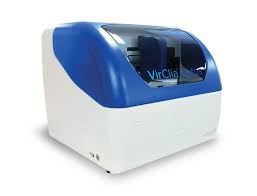
A compact automated CLIA platform for VirClia® infectious disease testing, combining ready-to-use single-test flexibility with continuous random access efficiency.
MORE RESOURCES

Related germs and organisms categorized for this product line.

Downloadable PDF materials, brochures, and technical documents.
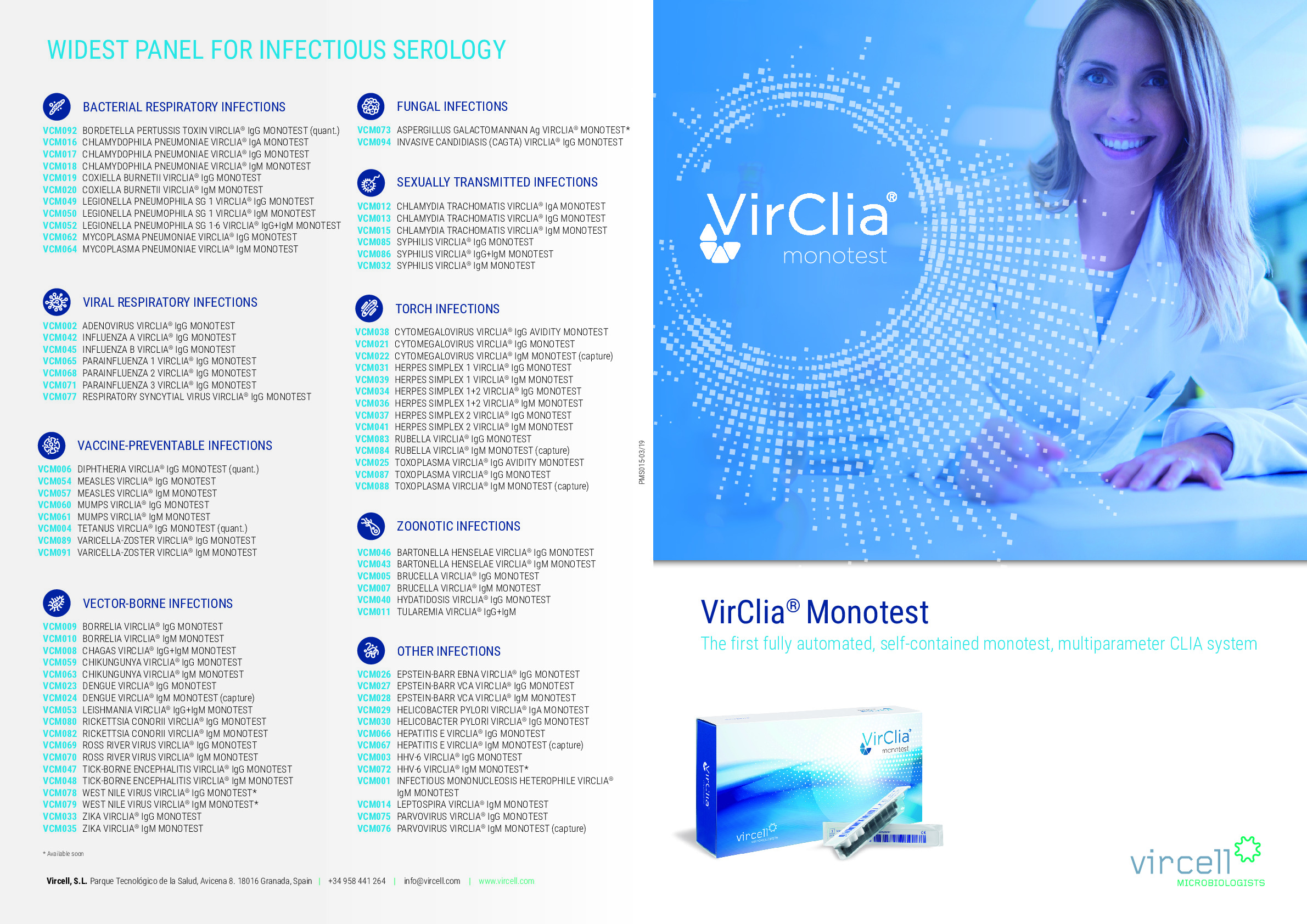

The latest insights, news, and research articles from our scientific team.

Understanding the complexity of vaginal infectionsVaginal infections are among the most frequent reasons for gynecological consultation, but their dia...

Beyond detection: H. pylori testing in today’s laboratory workflow
Helicobacter pylori remains a highly relevant target in gastrointestinal diagnostics. It is a familiar pathogen, but its clinical importance has not d...

Aspergillus galactomannan: a practical biomarker for invasive aspergillosis diagnosis
Invasive aspergillosis is still one of the most difficult fungal infections to diagnose early. It mainly affects patients with weakened immune systems...

Scientific bibliography and references related to this product.