
Background
Community-acquired pneumonia (CAP) remains one of the most relevant respiratory infections in clinical practice, both because of its frequency and its impact on morbidity, hospitalization and mortality, particularly in older adults and patients with underlying comorbidities. Its clinical presentation may range from mild disease to severe forms requiring hospital admission, making it a continuing diagnostic and healthcare challenge.
CAP may be caused by a wide variety of microorganisms. Among the pathogens most frequently involved are bacteria such as Streptococcus pneumoniae, Mycoplasma pneumoniae, Chlamydia pneumoniae and Legionella pneumophila, as well as respiratory viruses that may also contribute to the clinical picture or the differential diagnosis. This etiological diversity, together with possible variation according to patient age, geographical area and seasonality, makes it especially useful to have diagnostic tools capable of investigating several agents simultaneously.
In this context, the etiological diagnosis of pneumonia should not rely on a single parameter, but rather on the integration of clinical, radiological and microbiological information. The availability of multitest methods may provide added value by enabling a broader approach adapted to the complexity of community respiratory infections.
Product features
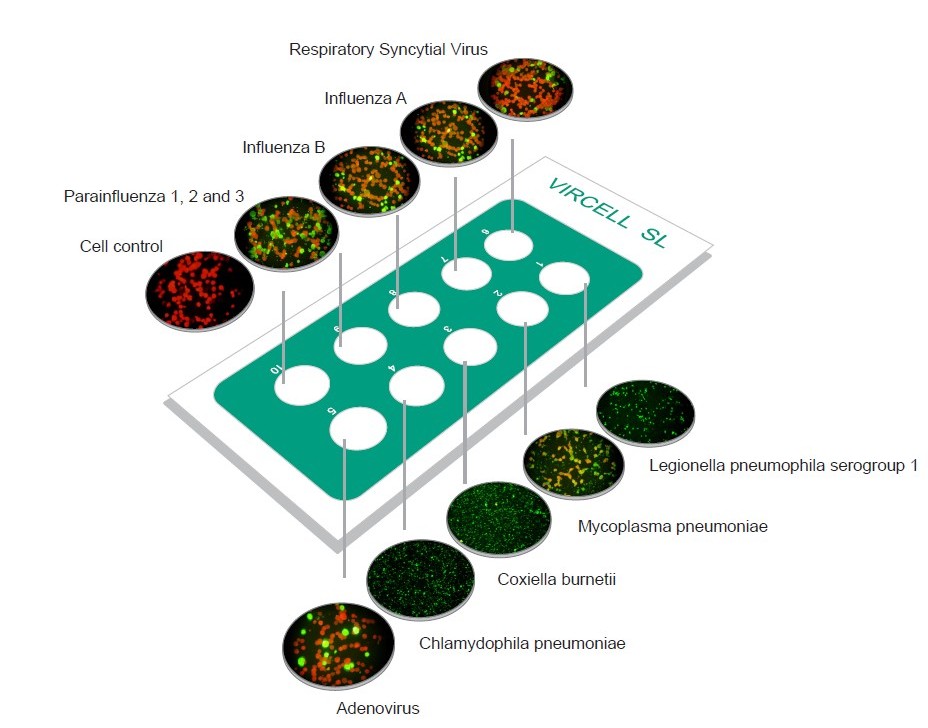
Simultaneous detection of the 9 microorganisms most frequently associated with atypical pneumonia (virus and bacteria)
Complete kits including all the necessary reagents to perform the technique
Cell control well in each slide
MIF assay for more specific results in C. pneumoniae
Incubation times and temperatures according to the worldwide scientific consensus
Easy results reading
Diagnostic Recommendations
IFA serology for respiratory agents associated with pneumonia
Results should be interpreted together with clinical information, radiology, time since symptom onset, patient age, seasonality and local epidemiology.
Detection of IgM against respiratory agents supports the diagnosis of recent infection, especially when the result is compatible with the clinical presentation.
Detection of IgG may indicate previous exposure or past infection. To support recent infection, seroconversion or a significant increase in titre in paired samples should be assessed.
Serology may be especially useful as a complementary tool when serological evidence is required, when an adequate respiratory sample is not available, or when the stage of disease favours an antibody response.
In infections caused by Mycoplasma pneumoniae, Chlamydia pneumoniae, Coxiella burnetii or Legionella pneumophila, serological interpretation should consider the time since symptom onset, the possibility of previous exposure and the need to confirm titre evolution in successive samples.
In infections caused by influenza A/B, RSV, adenovirus and parainfluenza, serology may support etiological assessment, especially in contexts where the antibody response is relevant for clinical or epidemiological interpretation.
A negative result does not exclude infection if the sample is collected at a very early stage, in cases of reinfection, weak humoral response or altered immune status.
Multiple or discordant results should be interpreted with caution, taking into account local prevalence, season, patient age and the possibility of non-specific reactivity.
The presence of antibodies should be integrated with other clinical and microbiological data, as serology alone does not define the site of infection, clinical severity, infectivity or treatment response.
When results are doubtful, unexpected or clinically incompatible, repeat testing with a second sample or the use of complementary methods according to the local diagnostic algorithm may be useful.
Sources
Metlay JP, Waterer GW, Long AC, Anzueto A, Brozek J, Crothers K, et al. Diagnosis and treatment of adults with community-acquired pneumonia. An official clinical practice guideline of the American Thoracic Society and Infectious Diseases Society of America. Am J Respir Crit Care Med. 2019;200(7). doi.org/10.1164/rccm.201908-1581ST
Anderson A, Bijlmer H, Fournier PE, Graves S, Hartzell J, Kersh GJ, et al. Diagnosis and management of Q fever — United States, 2013: recommendations from CDC and the Q Fever Working Group. MMWR Recomm Rep. 2013;62(RR-03):1-30. Available from: https://www.cdc.gov/mmwr/preview/mmwrhtml/rr6203a1.htm
Uyeki TM, Bernstein HH, Bradley JS, Englund JA, File TM Jr, Fry AM, et al. Clinical practice guidelines by the Infectious Diseases Society of America: 2018 update on diagnosis, treatment, chemoprophylaxis, and institutional outbreak management of seasonal influenza. Clin Infect Dis. 2019;68(6). doi.org/10.1093/cid/ciy866
PRODUCTS
PNEUMOSLIDE IgG
Analytes: Adenovirus, Coxiella burnetii, Chlamydophila pneumoniae, Influenza, Legionella pneumophila, Mycoplasma pneumoniae, Parainfluenza, Respiratory Syncytial Virus
PNEUMOSLIDE IgM
Analytes: Adenovirus, Coxiella burnetii, Chlamydophila pneumoniae, Influenza, Legionella pneumophila, Mycoplasma pneumoniae, Parainfluenza, Respiratory Syncytial Virus
MORE RESOURCES

Related germs and organisms categorized for this product line.

Downloadable PDF materials, brochures, and technical documents.


The latest insights, news, and research articles from our scientific team.

Understanding the complexity of vaginal infectionsVaginal infections are among the most frequent reasons for gynecological consultation, but their dia...

Beyond detection: H. pylori testing in today’s laboratory workflow
Helicobacter pylori remains a highly relevant target in gastrointestinal diagnostics. It is a familiar pathogen, but its clinical importance has not d...

Aspergillus galactomannan: a practical biomarker for invasive aspergillosis diagnosis
Invasive aspergillosis is still one of the most difficult fungal infections to diagnose early. It mainly affects patients with weakened immune systems...

Scientific bibliography and references related to this product.