
Background
Vaginal infections are among the most frequent reasons for gynaecological consultation and laboratory testing. Bacterial vaginosis is considered the most common vaginal condition among women aged 15–44. WHO estimates that bacterial vaginosis prevalence among women of reproductive age ranges from 23% to 29%, depending on population and geography. Vulvovaginal candidiasis is also highly prevalent: around 75% of women will have at least one episode during their lifetime, and 40–45% will have two or more. Symptoms of bacterial flora imbalance, candidiasis and trichomoniasis may overlap, making interpretation difficult from clinical signs alone. Microscopy and clinical criteria may be influenced by operator experience, sample quality and subjective interpretation. Laboratories need objective information to help distinguish bacterial imbalance, Candida species and Trichomonas vaginalis in a practical workflow.

Product information
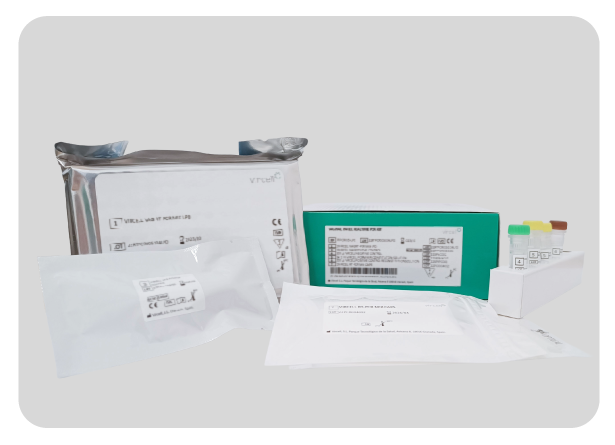
VIRPLEX Vaginal Panel provides semi-quantitative information for vaginal flora interpretation.
It includes Lactobacillus spp., Gardnerella vaginalis and Atopobium vaginae to support assessment of bacterial flora balance.
The panel also detects Trichomonas vaginalis, a key agent in vaginal infection workflows.
For Candida, it includes Candida albicans, Candida glabrata, Candida krusei and other clinically relevant Candida species. This is particularly useful because non-albicans Candida species may be associated with different antifungal susceptibility profiles.
Automatic interpretation through VIRCOM helps reduce manual calculations and transcription errors.
Diagnostic Recommendations
Results should always be interpreted together with symptoms, clinical evaluation, patient history and other diagnostic procedures.
A positive result indicates detection of the corresponding target in the vaginal sample, but does not by itself define disease severity, microorganism viability or treatment response.
The bacterial vaginosis result reflects the molecular balance between Lactobacillus spp. and BV-associated bacteria such as Gardnerella vaginalis and Atopobium vaginae. Detection of G. vaginalis or A. vaginae alone does not necessarily indicate bacterial vaginosis, as these bacteria may also be present in the vaginal microbiota.
The vaginal flora grade helps describe the molecular profile of the sample, but should be interpreted according to the patient’s symptoms and clinical context.
Candida, Trichomonas vaginalis and bacterial vaginosis results should be interpreted independently, as mixed infection profiles may occur.
A positive Candida result indicates detection of the corresponding target in the sample. In complicated, recurrent or persistent vulvovaginal candidiasis, species-level identification may support clinical decision-making.
A positive Candida spp. result indicates detection of the grouped target including C. parapsilosis, C. tropicalis and/or C. dubliniensis. The assay does not differentiate between these species.
The assay does not differentiate Candida albicans from Candida africana, and does not differentiate Candida krusei from Candida inconspicua.
A positive Trichomonas vaginalis result supports the diagnosis of trichomoniasis in the appropriate clinical and epidemiological context. As T. vaginalis is sexually transmitted, patient management should follow local STI guidance, including partner management where appropriate.
A negative result does not exclude infection when the target is present below the limit of detection, specimen quality is suboptimal, amplification inhibitors are present, or another microorganism not included in the assay is involved.
Invalid or inconclusive results should be repeated, preferably after re-extraction from the original specimen. If poor sample quality or inhibition is suspected, a new sample should be considered.
Sources:
Workowski KA, Bachmann LH, Chan PA, Johnston CM, Muzny CA, Park I, et al. Sexually transmitted infections treatment guidelines, 2021. MMWR Recomm Rep. 2021;70(4):1-187. doi.org/10.15585/mmwr.rr7004a1
Sherrard J, Wilson J, Donders G, Mendling W, Jensen JS. 2018 European IUSTI/WHO guideline on the management of vaginal discharge. Int J STD AIDS. 2018;29(13):1258-1272. doi.org/10.1177/0956462418785451
Saxon C, Edwards A, Rautemaa-Richardson R, Owen C, Nathan B, Palmer B, et al. British Association for Sexual Health and HIV national guideline for the management of vulvovaginal candidiasis (2019). Int J STD AIDS. 2020;31(12):1124-1144. doi.org/10.1177/0956462420943034
PRODUCTS
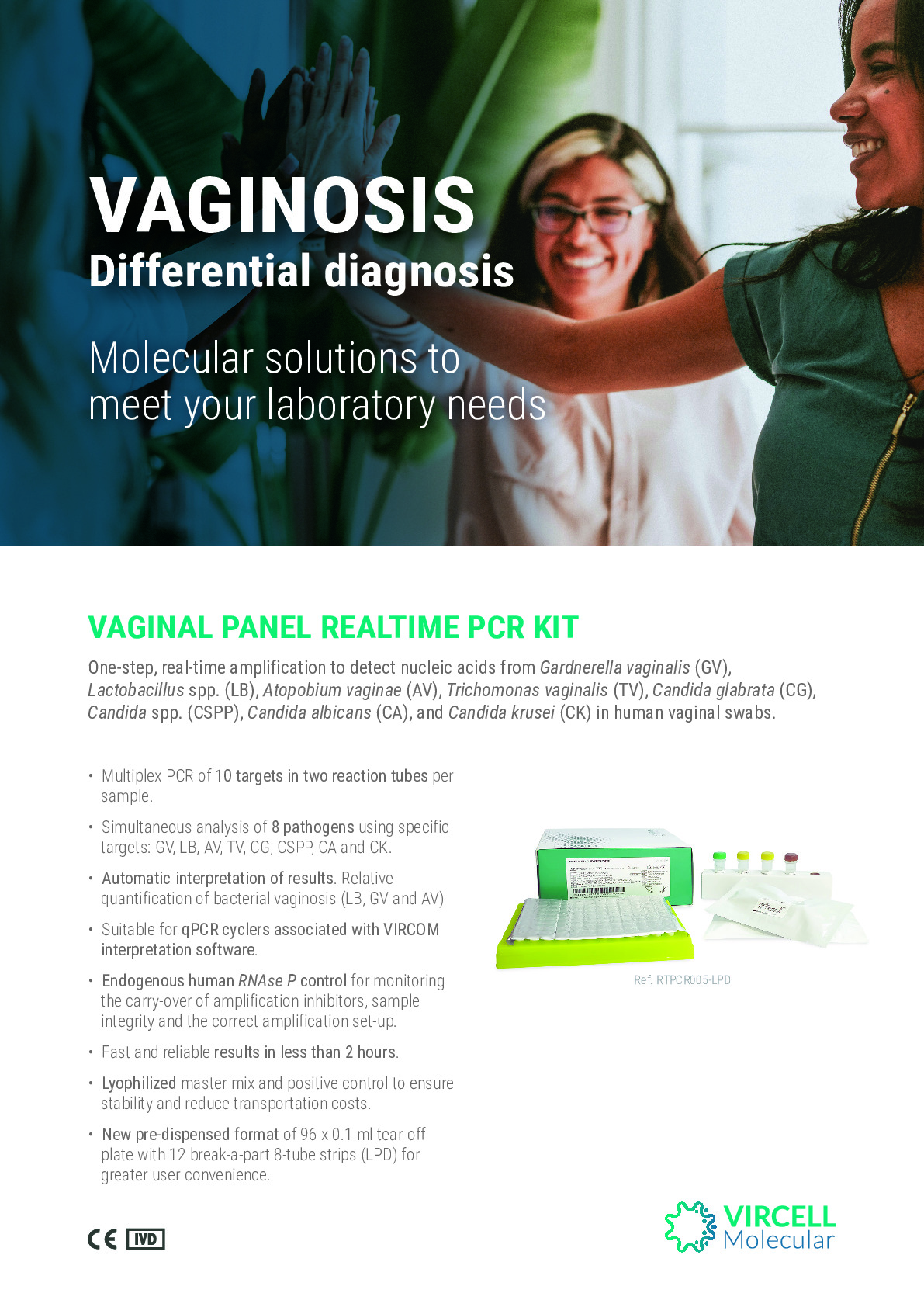
VAGINAL PANEL REALTIME PCR KIT
Analytes: Atopobium vaginae, Candida albicans, Candida dubliniensis, Candida glabrata, Candida krusei, Candida parapsilosis, Gardnerella vaginalis, Lactobacillus, Trichomonas vaginalis
MORE RESOURCES

Related germs and organisms categorized for this product line.

Downloadable PDF materials, brochures, and technical documents.

The latest insights, news, and research articles from our scientific team.

Understanding the complexity of vaginal infectionsVaginal infections are among the most frequent reasons for gynecological consultation, but their dia...
Beyond detection: H. pylori testing in today’s laboratory workflow
Helicobacter pylori remains a highly relevant target in gastrointestinal diagnostics. It is a familiar pathogen, but its clinical importance has not d...

Aspergillus galactomannan: a practical biomarker for invasive aspergillosis diagnosis
Invasive aspergillosis is still one of the most difficult fungal infections to diagnose early. It mainly affects patients with weakened immune systems...